A Habsburg capital at one end, a Venetian coastline at the other, and eight national parks in between — all within a few hours' drive.
Croatia packs an improbable amount into a country the size of West Virginia: a thousand-island Adriatic coastline, eight national parks, Roman amphitheatres and walled medieval towns still lived in rather than roped off. Most visitors know the postcard south — Dubrovnik's ramparts, Split's palace, the beaches of Hvar and Brač — but the country reads very differently inland, where Zagreb keeps a Habsburg capital's museums and café culture and the hills of Zagorje hide castles and thermal spas. Distances are short and the roads are good, so a single trip can reasonably take in a waterfall park, a Roman ruin and an island in the same week.
The best-value window on the coast: the Adriatic towns reopen without the crowds, the waterfall parks run high with snowmelt, and the interior turns green. The sea is still cold for swimming until late May, and some island ferries run reduced winter timetables into April.
SummerJun–Aug
Hot, dry and busy. This is when the islands, sailing and beach season are in full swing and every ferry runs at full frequency, but Dubrovnik and Split are at their most crowded and the midday heat inland can be fierce. Book accommodation and car hire well ahead.
FallSep–Nov
September is arguably the sweet spot — the sea is still warm from summer, the crowds thin out and prices drop. October brings truffle season in Istria and the grape harvest inland; by November the coast is quiet and many island businesses close for winter.
WinterDec–Feb
The coast largely shuts down, but the interior comes into its own: Zagreb's Advent market is a genuine highlight, the Zagorje thermal spas are at their most appealing, and skiing runs on Sljeme above the capital. Expect cold, grey weather inland and the bura wind on the coast.
Regions
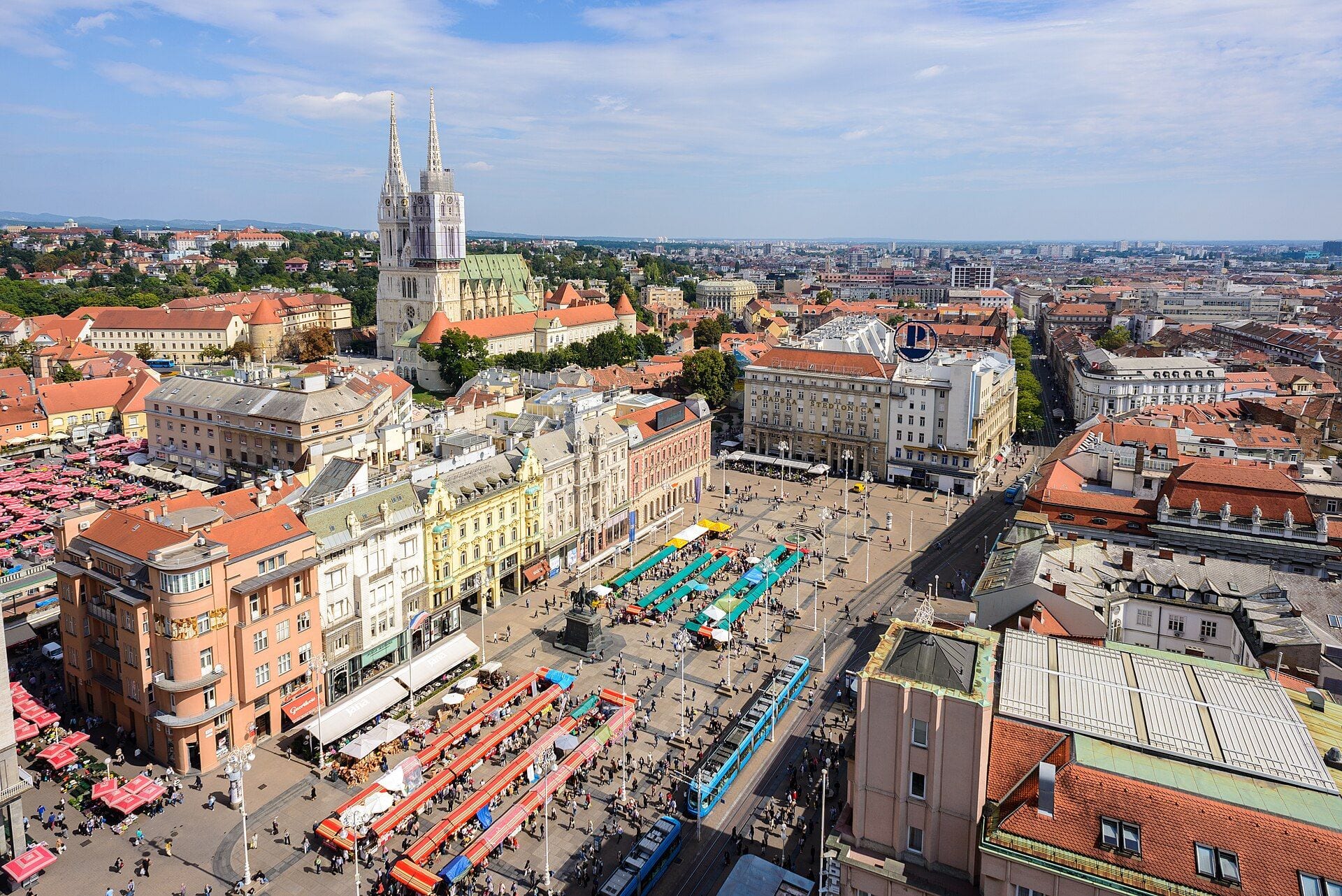
Zagreb & continental CroatiaThe capital and its hinterland, and the half of the country most visitors skip. Zagreb has the museums, the café culture and the Habsburg architecture; north of it the Zagorje hills hold hilltop castles, thermal spas and the Neanderthal site at Krapina, while Varaždin preserves a compact baroque town centre.
IstriaThe heart-shaped peninsula in the northwest, closer in feel to Italy than to Dalmatia. Pula has a remarkably intact Roman amphitheatre, Rovinj and Poreč are Venetian-era coastal towns, and the inland hill towns of Motovun and Grožnjan sit above oak forests famous for truffles and the country's best-regarded wines.
Kvarner & the northern islandsThe gulf between Istria and Dalmatia, where the Habsburg resort town of Opatija set the template for Adriatic tourism. Rijeka is the working port city, and the islands of Krk, Cres, Lošinj and Rab are quieter and greener than their southern counterparts — Krk is reachable by bridge.
Northern DalmatiaZadar and Šibenik anchor a stretch of coast with two of the country's finest parks close at hand: Krka, where boardwalks run beside travertine waterfalls, and the Kornati archipelago, a scatter of near-barren islands best seen by boat. Plitvice Lakes sits inland, roughly midway between here and Zagreb.
Split & central DalmatiaThe busiest part of the coast and the main gateway to the islands. Split is built inside and around Diocletian's Roman palace, Trogir is a compact walled town just up the coast, and the ferries run out to Brač, Hvar, Vis and Korčula — the classic island-hopping cluster.
Dubrovnik & the far southThe southern tip, reached along a narrow coastal strip. Dubrovnik's walled old town is the country's signature sight and correspondingly crowded; the Pelješac peninsula behind it is a serious wine region, and the wooded island of Mljet — half of it national park — is the quiet counterweight.
Croatia's signature sights at a glance
Dubrovnik's city wallsA complete circuit of 13th-century fortifications you can walk right around, looking down over terracotta roofs and out to the Adriatic.Basecamp: Dubrovnik
Diocletian's PalaceA Roman emperor's retirement palace that never became a ruin — Split simply kept living inside it, so the colonnades now hold cafés, flats and churches.Basecamp: Split
Plitvice Lakes National ParkSixteen terraced lakes linked by waterfalls, crossed on timber boardwalks; the country's oldest national park and its most-visited natural site.Basecamp: Zagreb or Zadar
Pula ArenaOne of the six largest surviving Roman amphitheatres anywhere, and the only one to retain its complete outer wall with all four side towers.Basecamp: Pula
Krka National ParkTravertine waterfalls stepping down a river gorge, with boardwalk trails and a monastery island upstream — easier to reach in a day than Plitvice.Basecamp: Šibenik
Suggested routes
The classic Adriatic run
~10–14 days
The trip most first-time visitors come for: down the length of the coast from the capital to the far south, taking in a waterfall park, a Roman city and a couple of islands. Doable by bus and ferry, but far better with a car for the inland stops.
A compact loop of the northwestern peninsula, mixing Roman ruins, Venetian harbour towns and inland hill villages. Short driving distances make this the least demanding Croatian itinerary, and the food is the best in the country.
1Pula — the amphitheatre and the Roman core
2Rovinj — the most photogenic coastal town
3Poreč — the mosaics of the Euphrasian Basilica
4Motovun & Grožnjan — hill towns, truffles and wine
5Opatija — Habsburg seafront promenade
Continental Croatia
~4–5 days
The inland half of the country, and an easy add-on to a Zagreb city break. Castles, spa towns and baroque squares, with almost none of the coastal crowds — best in late spring or early autumn.
5Osijek & Kopački rit — Slavonia and the Danube wetlands
Croatia travel FAQ
Eight questions travellers ask before they go.
When is the best time to visit Croatia?
Late spring (May–June) and early September are the sweet spots: warm enough to swim, quiet enough to enjoy Dubrovnik and Split, and cheaper than peak season. July and August are hottest and busiest, with every ferry and island at capacity. Spring is best for the waterfall parks, which run highest with snowmelt. Winter closes much of the coast but is the right time for Zagreb, the Advent market and the inland spas.
How many days do you need in Croatia?
A week is enough for one region — Istria, or Split and a couple of islands, or Dubrovnik and the far south. Ten days to two weeks lets you run the classic coastal route from Zagreb down to Dubrovnik with a national park and an island or two along the way. Trying to combine Istria and Dubrovnik in under ten days means spending most of it driving, since they sit at opposite ends of a long country.
Do you need a car in Croatia?
It depends on the trip. For Istria, the Zagorje hills and the national parks a car is close to essential, and it makes the coastal route far more flexible. For a city-and-islands trip you can manage entirely on buses, ferries and catamarans, which are frequent and inexpensive. Cars are actively unhelpful inside the walled old towns of Dubrovnik, Split, Trogir and Korčula, all of which are pedestrianised with costly perimeter parking.
What is Croatia known for?
Its Adriatic coastline above all — more than a thousand islands, clear water and walled medieval towns — along with Dubrovnik's ramparts, Diocletian's Palace in Split, and the terraced waterfalls of Plitvice and Krka. It is also the birthplace of the necktie, the home of the Dalmatian dog, and a serious wine and truffle producer, particularly in Istria.
Is English widely spoken in Croatia?
Yes, very widely, especially among younger people and anywhere connected to tourism — hotels, restaurants, ferry offices and national parks all operate comfortably in English. German and Italian are also common on the coast. Learning a few words of Croatian is appreciated but rarely necessary.
What currency does Croatia use, and is it in the EU?
Croatia uses the euro. It joined the EU in 2013 and adopted the euro on 1 January 2023, retiring the kuna — older guidebooks and websites still quoting kuna prices are out of date, and the currency is no longer accepted. Croatia joined the Schengen area on the same date, so there are no routine border checks with EU neighbours, though land crossings into Bosnia and Herzegovina, Montenegro and Serbia remain external borders. Cards are accepted almost everywhere; carry some cash for small island businesses and market stalls.
What should you eat in Croatia?
The food splits along the same line as the geography. On the coast expect grilled fish, black risotto, oysters from Ston and peka — meat or octopus slow-cooked under a bell-shaped lid. Inland the cooking is central European: štrukli (baked cheese pastry) around Zagreb, hearty stews, freshwater fish in Slavonia and paprika-heavy dishes near the Hungarian border. Istria is the country's gastronomic centre, known for truffles, olive oil and prosciutto.
What kind of trip is Croatia best for?
Coastal road trips, sailing and Roman history.
We use cookies to analyse site traffic and improve your experience.
You can accept or reject analytics cookies. See our Cookie Policy.