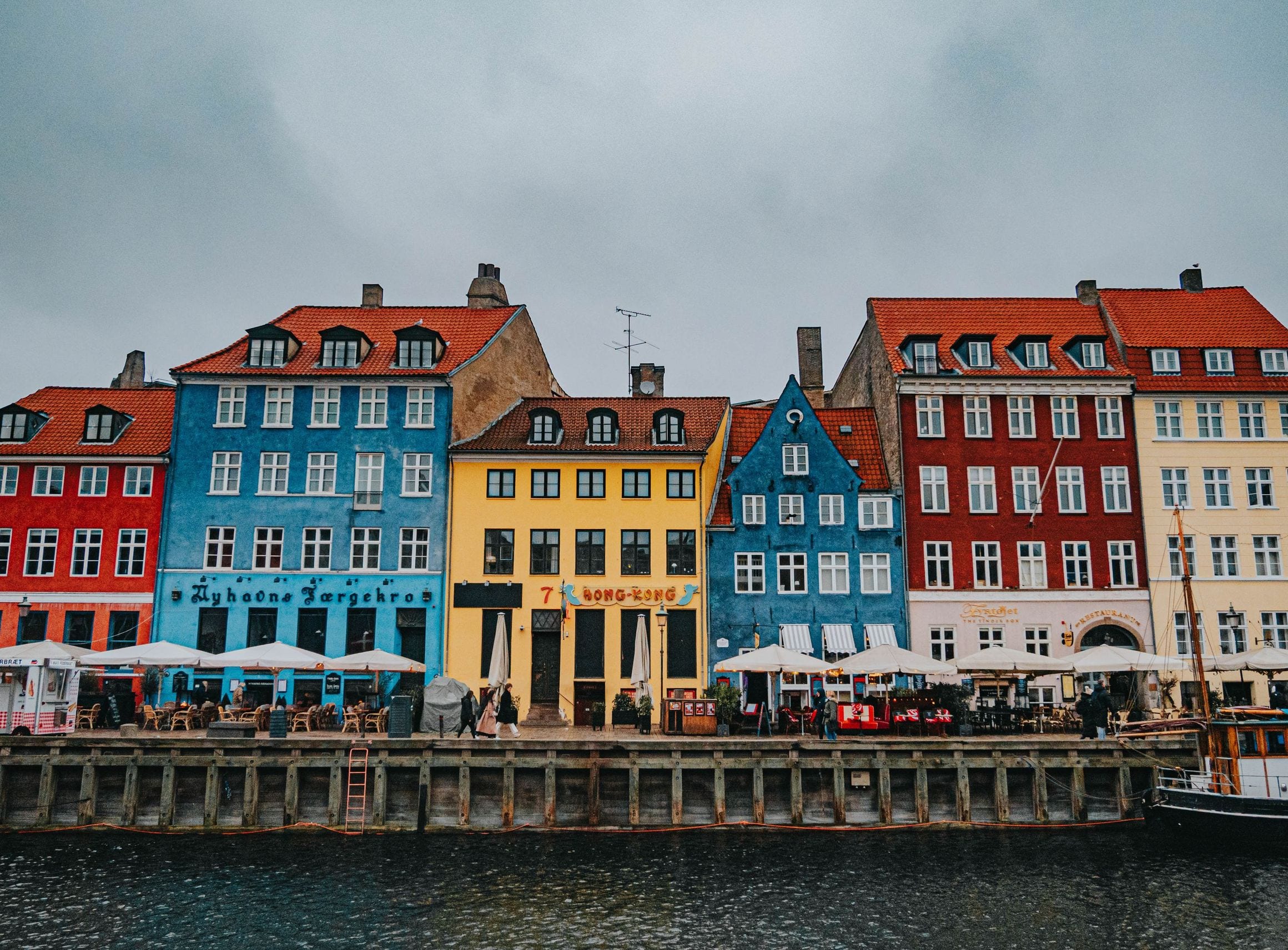
A country you can cross in a morning and spend a fortnight getting lost in — castles, coastline and the world's most liveable capital.
Denmark is the smallest and most walkable of the Nordic countries — a low, green sweep of peninsula and islands where design-obsessed cities sit within an hour or two of white chalk cliffs, windswept dune coasts and some of the oldest royal castles in Europe. Copenhagen anchors it with harbour baths, cycle bridges and New Nordic kitchens, while Jutland and Funen hold half-timbered market towns, the Wadden Sea and beaches that run for miles. Distances are short, the trains and bikes do the work, and nowhere is far from the sea. Use this hub to plan your trip: browse our Danish city guides below, or read on for the regions, seasons and routes that tie the country together.
The country thaws late and then moves fast: parks green up, harbour cafés put chairs outside, and the beech woods come into leaf in early May — a moment Danes treat as a national event. Expect cool, changeable weather and long, bright evenings by the end of the season.
SummerJun–Aug
The best and busiest stretch, with daylight running past 10pm around midsummer, warm-enough sea for swimming off the beaches and harbour baths, and every coastal town at full tilt. Temperatures are mild rather than hot, and a rain jacket is never wasted.
FallSep–Nov
September keeps much of summer's light with thinner crowds and is one of the best months to travel. From October the weather turns grey, wet and windy, the coast empties out, and the cities lean indoors into museums, cafés and candlelight.
WinterDec–Feb
Short, dark days — barely seven hours of light around the solstice — offset by Christmas markets, Tivoli's winter season and the full force of hygge. Snow is occasional rather than reliable; the real winter constants are wind, rain and early sunsets.
Regions
Copenhagen & North ZealandThe capital and its hinterland, where a harbour city of cycle bridges, palaces and New Nordic restaurants sits half an hour by train from the royal castle belt — Kronborg at Elsinore, moated Frederiksborg, and the modern-art museum at Humlebæk looking across the sound to Sweden.
Zealand & the southern islandsBeyond the capital's commuter belt lie Roskilde's Viking ships and cathedral, the Stevns Klint cliffs, and the chalk-white drama of Møns Klint on the island of Møn — plus the quiet beaches and dark night skies of Lolland and Falster.
Funen & the archipelagoThe orchard island in the middle of the country, with Hans Christian Andersen's Odense at its heart, manor houses and half-timbered villages inland, and a scatter of small sailing islands — Ærø, Tåsinge, Langeland — strung out to the south.
East JutlandDenmark's second city, Aarhus, brings a rainbow-roofed art museum, an open-air old town and a young university energy, with the forested hills and beach towns of Djursland and the lake district around Silkeborg within easy reach.
North JutlandThe wild top of the country, where the dunes and shifting sands run out to Skagen — the artists' town at the tip, where the Baltic and the North Sea visibly collide — with the Limfjord, Aalborg and long empty beaches on the way up.
South & West JutlandThe oldest and most elemental corner: Ribe, Denmark's earliest town, the tidal flats and vast starling flocks of the UNESCO Wadden Sea, the surf beaches of the west coast, and Billund, where Lego was invented and Legoland still draws families from across Europe.
Kronborg CastleThe UNESCO-listed Renaissance fortress at Elsinore guarding the narrowest point of the Øresund, known worldwide as the setting of Shakespeare's Hamlet.Basecamp: Helsingør
Møns KlintChalk cliffs rising over 100 metres straight out of turquoise water on the island of Møn, backed by beech forest and one of Denmark's few dark-sky reserves.Basecamp: Møn
Skagen & GrenenThe sandy spit at Denmark's northern tip where two seas meet in a visible line of colliding surf, beside the artists' town whose light drew a whole 19th-century painting school.Basecamp: Skagen
The Wadden SeaA UNESCO tidal wilderness on the west coast — oyster beds, seals and the 'black sun', the vast twisting starling murmurations that darken the sky at dusk in spring and autumn.Basecamp: Ribe
Suggested routes
Copenhagen & the castle belt by train
~4–5 days
The easiest introduction to Denmark and the one that needs no car at all: a few days in the capital, then short local-train hops north along the Øresund coast to the royal castles and the country's best-known art museum. Every stop below is under an hour from Copenhagen.
1Copenhagen — two to three days; harbour, palaces & Tivoli
2Roskilde — Viking ships & the royal burial cathedral
3Hillerød — moated Frederiksborg Castle
4Humlebæk — modern art above the sound
5Helsingør — Kronborg, Hamlet's Elsinore
Across the islands to Jutland
~1–2 weeks
The classic coast-to-coast run, following the rail spine west from the capital over the Great Belt to Funen and on into the peninsula, then north to the tip. Doable entirely by train, though a car helps for the last stretch.
The wild, weather-beaten side of Denmark, and the one route that genuinely wants a car: dune plantations, surf beaches, tidal flats and the country's oldest town, ending at the sand-blown northern point.
1Billund — Legoland & the Lego House
2Ribe — Denmark's oldest town
3The Wadden Sea — tidal flats, seals & the black sun
Late spring and early autumn — May, June and September — hit the sweet spot: long daylight, mild weather, open terraces and fewer crowds than peak summer. July and August are warmest and best for the beaches and islands, but also the busiest and priciest. Winter is dark and wet, with barely seven hours of daylight around the solstice, though Copenhagen's Christmas markets and Tivoli's winter season are a genuine draw.
How many days do you need in Denmark?
Three to four days covers Copenhagen properly, including a castle or museum day trip up the coast. A week lets you add Odense and Aarhus by train, and ten days to two weeks is enough to reach Jutland's west coast, the Wadden Sea and Skagen at a comfortable pace. Because the country is small and the trains are quick, you can see a surprising amount in a short trip.
Do you need a car in Denmark?
Not for the cities. Trains connect Copenhagen, Odense, Aarhus and Aalborg frequently, and both Copenhagen and Aarhus are best explored by bike or on foot. A car is worth having for the Jutland coast, the Wadden Sea and island-hopping around Funen and the south, where bus and train service thins out. Note that the big bridges — the Great Belt and the Øresund — carry tolls.
What is Denmark known for?
Design and architecture, cycling culture, hygge, and a food scene that reinvented Nordic cooking. It is also a country of castles and Viking history, of Lego and Hans Christian Andersen, and of coastline — no point in Denmark is more than about 50 km from the sea, and the beaches, dunes and chalk cliffs are as much a part of a trip as the cities.
Do people speak English in Denmark?
Almost universally. English is taught from early primary school and spoken fluently by the large majority of Danes, especially in cities and anywhere connected to tourism. Menus, museum labels and transport signage are routinely bilingual, and you can travel the whole country comfortably without a word of Danish — though a 'tak' for thank you is always well received.
Does Denmark use the euro?
No. Denmark is a member of the European Union but not the eurozone, and keeps its own currency, the Danish krone (DKK, written 'kr.'), which is pegged to the euro. Euro cash is not generally accepted outside a few tourist spots. In practice this matters little: Denmark is close to cashless, and cards and phone payments work essentially everywhere, including on buses and in small cafés.
What food should you try in Denmark?
Smørrebrød — the open rye sandwich, layered with pickled herring, roast pork, shrimp or roast beef and remoulade — is the national dish and the thing to seek out at lunch. Beyond it: pastries from a proper bakery (what the rest of the world calls Danish), pølser from a street sausage wagon, new potatoes and asparagus in early summer, and the New Nordic restaurants that made Copenhagen a global food destination.
What kind of trip is Denmark best for?
City breaks, coastal road trips and family travel.
We use cookies to analyse site traffic and improve your experience.
You can accept or reject analytics cookies. See our Cookie Policy.