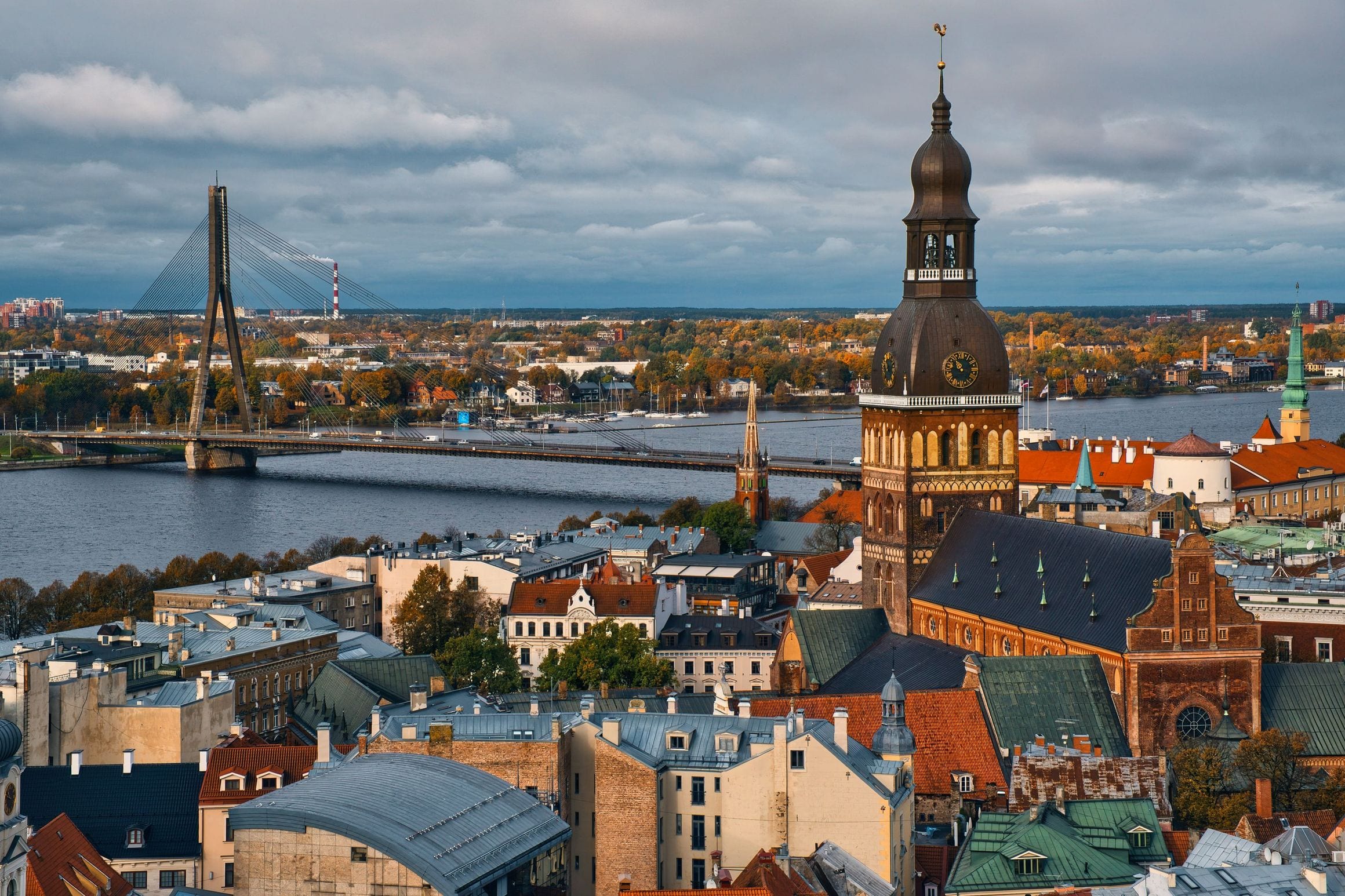
An Art Nouveau capital, empty white-sand beaches and pine forest to the horizon — the Baltic at its most quietly grand.
Latvia packs an improbable amount into a country of under two million people: a UNESCO-listed capital of Art Nouveau facades and medieval spires, some 500 kilometres of white-sand Baltic coast, and a hinterland of pine forest, sandstone gorges and blue lakes. Riga is the obvious way in — the largest city in the Baltics and by far its most architecturally extravagant — but the country rewards anyone who keeps going, to the castles of the Gauja valley, the wooden spa villas of Jurmala and the quiet lake country of Latgale. Use this hub to plan your trip: browse our Latvian city guides below, or read on for the regions, seasons and routes that tie the country together.
A slow thaw into one of the loveliest times to visit: the snow clears, Riga's parks and canal-side greens come back to life, and by May the cafe terraces are open and the birch woods are in fresh leaf. Early spring is still raw and grey, so late April and May are the sweet spot.
SummerJun–Aug
Peak season, and the reason Latvians decamp to the coast. Northern days stretch past ten in the evening around midsummer, the Baltic warms just enough to swim in, and the resort towns fill up. Warm rather than hot, with the occasional thundery spell.
FallSep–Nov
September is a genuinely good month — mild, golden and far quieter than August, with the forests turning and mushroom season in full swing. From late October it turns dark, wet and cold, and the coast empties out almost completely.
WinterDec–Feb
Cold, dark and often snowy, with short days and temperatures regularly below freezing. Riga is at its most atmospheric under snow, with a Christmas market on Dome Square, while the frozen lakes and forests inland draw skiers, skaters and ice fishers.
Regions
Riga & aroundThe capital and its immediate hinterland, where a UNESCO-listed medieval core sits alongside the largest concentration of Art Nouveau architecture in Europe — with the Central Market's converted zeppelin hangars, the wooden suburbs of Kipsala and Agenskalns, and the forest park and zoo at Mezaparks all inside the city limits.
Jurmala & the Gulf coastThe strip of white sand and pine forest immediately west of Riga, where a 19th-century spa resort of ornate carved wooden villas runs for kilometres along the Gulf of Riga, barely half an hour from the capital by commuter train.
Vidzeme & the Gauja valleyLatvia's most-visited region outside the capital: the red sandstone cliffs, caves and forested river bends of Gauja National Park, with the castles of Sigulda, Turaida and Cesis strung along the valley and a long, quiet coastline running northeast toward Estonia.
Kurzeme & the west coastThe wild western province, where the open Baltic meets the Gulf of Riga at Cape Kolka, lighthouses and near-empty beaches run south through Ventspils to Liepaja, and the old town of Kuldiga — with the widest waterfall in Europe on its doorstep — joined the UNESCO list in 2023.
Zemgale & the palace countryThe flat, fertile plain south of Riga, historically the heart of the Duchy of Courland and Semigallia and still the country's breadbasket, with the Baroque palace and formal gardens at Rundale and the castle and old town of Bauska as its headline draws.
Latgale & the blue lakesThe southeastern corner, quieter and more Catholic and Orthodox than the rest of the country, known as the land of blue lakes for the thousands scattered across it — with Daugavpils and its Mark Rothko centre and the great pilgrimage basilica at Aglona.
Latvia's signature sights at a glance
Riga Old TownA UNESCO-listed medieval core of cobbled lanes, guild halls, merchant houses and church spires, small enough to cross on foot in twenty minutes.Basecamp: Riga
Riga's Art Nouveau districtThe densest concentration of Jugendstil architecture anywhere in Europe, centred on Alberta iela, where the facades are stacked with masks, sphinxes and screaming faces.Basecamp: Riga
Riga Central MarketFive converted Zeppelin hangars holding one of the largest markets in Europe — still the city's working food hall, not a tourist set piece.Basecamp: Riga
Gauja National ParkLatvia's largest national park: red sandstone cliffs, caves and forest along the Gauja river, with the castles of Sigulda and Turaida standing above the valley.Basecamp: Sigulda
Rundale PalaceAn 18th-century Baroque palace by Bartolomeo Rastrelli, architect of the Winter Palace, with restored state rooms and formal French gardens.Basecamp: Bauska
JurmalaKilometres of white-sand Baltic beach backed by pine woods and ornate wooden spa villas, half an hour from Riga by train.Basecamp: Jurmala
Suggested routes
Riga in a long weekend
~3 days
The classic short break, and the trip most visitors to Latvia actually take. Everything here is walkable or a short tram ride apart, with one easy train trip to the coast to finish.
1Riga Old Town — the UNESCO medieval core
2The Art Nouveau district — Alberta iela and around
3Riga Central Market — lunch in the zeppelin hangars
4Jurmala — half-hour train to the beach
The Gauja valley castle run
~2–3 days
The easiest escape from the capital into real Latvian countryside — sandstone gorges, forest and a run of castles, all reachable by train from Riga if you'd rather not drive.
1Riga — start here
2Sigulda — cable car over the Gauja gorge
3Turaida — the red-brick castle and museum park
4Cesis — medieval castle ruins and old town
The Kurzeme coast loop
~4–5 days
A driving loop up the west coast and back, taking in lighthouses, near-empty beaches and the wooden towns of the old Duchy of Courland. A car is close to essential for this one.
1Riga — pick up the car here
2Jurmala — the resort strip
3Cape Kolka — where two seas meet
4Ventspils — port town and long sand beach
5Kuldiga — UNESCO old town and the wide falls
6Liepaja — music city and the Karosta naval quarter
Latvia travel FAQ
Eight questions travellers ask before they go.
When is the best time to visit Latvia?
Late spring through early autumn (May to September) is the most reliable window: mild to warm weather, long daylight and everything on the coast open. June and July are warmest and busiest, while September is quieter and often golden. Winter is cold, dark and frequently snowy — atmospheric in Riga, but limiting elsewhere in the country.
How many days do you need in Latvia?
Three days covers Riga properly, including the Old Town, the Art Nouveau district and the Central Market. Five to seven lets you add Jurmala and the Gauja valley castles at Sigulda and Cesis. Around ten days is enough to reach the Kurzeme coast or the lakes of Latgale as well.
Do you need a car in Latvia?
Not for Riga, which is walkable and has a dense tram and bus network, and not for Jurmala or Sigulda, which are straightforward commuter-train trips. A car becomes worthwhile for the Kurzeme coast, the manor houses of Zemgale and the back roads of Latgale, where bus and train timetables are sparse.
What is Latvia known for?
Riga's Art Nouveau architecture and UNESCO-listed old town, a long white-sand Baltic coastline, vast pine and birch forest, a powerful choral tradition centred on the Song and Dance Festival, and Riga Black Balsam, the bitter herbal liqueur the city has been making since the 18th century.
Do people speak English in Latvia?
Widely in Riga and the main tourist towns, especially among younger Latvians and in hotels, restaurants and museums. It thins out in rural areas and among older people, where Latvian and Russian dominate, but travellers rarely run into real difficulty.
What currency does Latvia use, and is it in the EU?
Latvia uses the euro, adopted in 2014. It is a member of the European Union, the eurozone, the Schengen Area and NATO, so most European visitors arrive without a border check and without needing to change money.
What food is Latvia known for?
Hearty and seasonal cooking: dark rye bread, grey peas with bacon, smoked fish from the Baltic, cold beetroot soup in summer, and pickles and wild mushrooms in autumn. Riga also has a fast-growing modern restaurant scene, and the Central Market is the best place to graze cheaply.
What kind of trip is Latvia best for?
City breaks, coastline and wooden architecture.
We use cookies to analyse site traffic and improve your experience.
You can accept or reject analytics cookies. See our Cookie Policy.