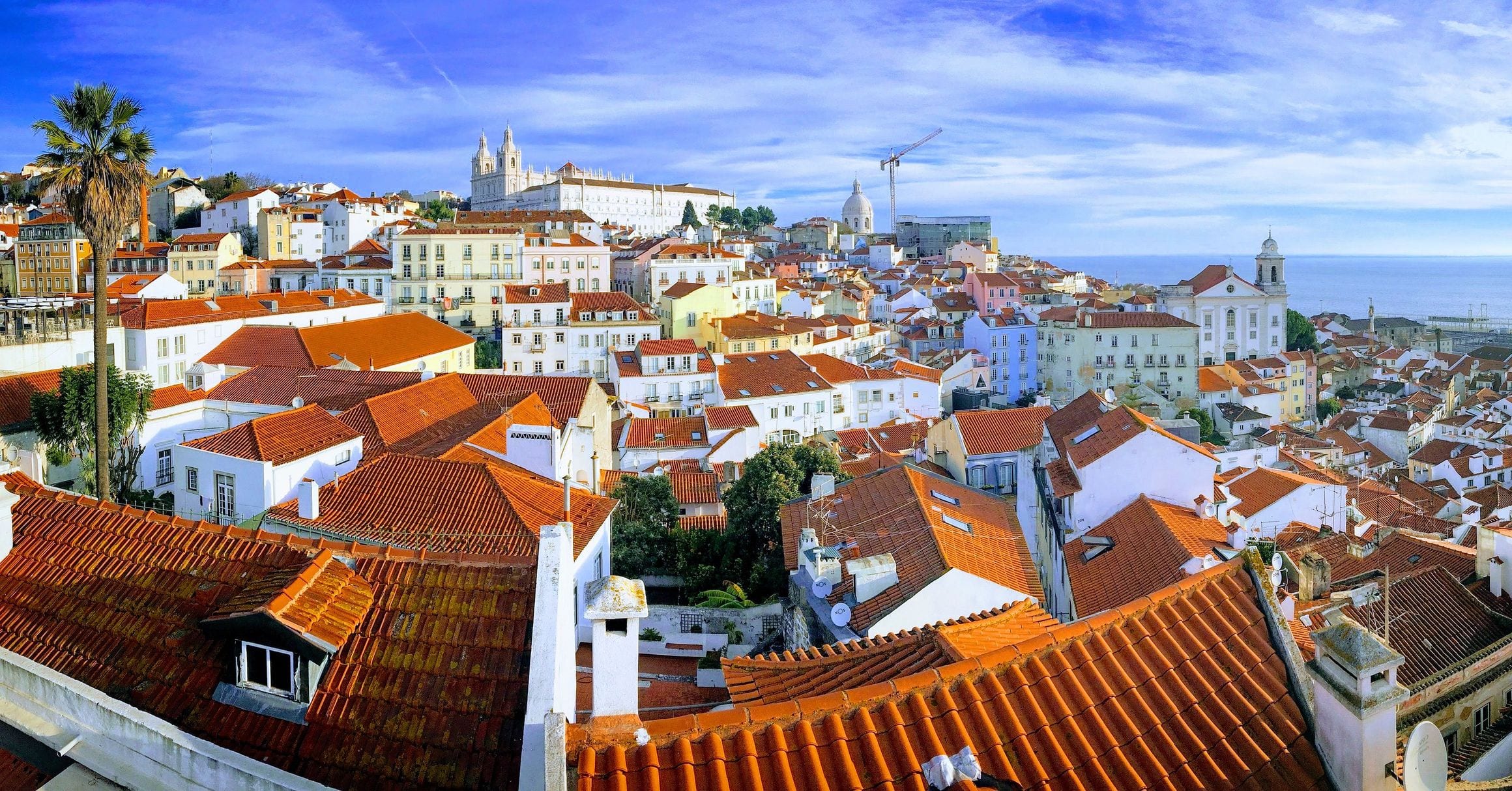
A small country with a long coast and a longer memory — explorers' monuments, tiled churches, terraced vineyards and an Atlantic that shapes everything.
Portugal occupies the western edge of Europe, a long, narrow country where Atlantic light, tiled facades and 800 years of seafaring history meet some of the continent's best-value food and wine. Lisbon spills across seven hills above the Tagus, Porto guards the mouth of the Douro and its terraced vineyards, and between them lie walled hill towns, pine-backed surf beaches and the empty cork plains of the Alentejo. South, the Algarve breaks into ochre sea cliffs and hidden coves; far offshore, Madeira and the Azores add volcanic peaks and laurel forest. Use this hub to plan where to go and what to see across the country.
Arguably the best window in the country: hillsides green, wildflowers across the Alentejo, comfortable walking temperatures in the cities and long daylight without the summer crush. The sea is still cold for swimming, and spring showers are common in the north, but Lisbon and the Algarve are already reliably mild.
SummerJun–Aug
Hot, dry and busiest. The Algarve and the Lisbon coast fill up, inland Alentejo can push well past comfortable in the afternoons, and the north stays a little cooler and greener. It is the season for beaches, festivals and late dinners outdoors — book ahead and plan sightseeing for mornings.
FallSep–Nov
September and October are a second sweet spot — the sea is at its warmest after a summer of sun, the Douro comes alive with the grape harvest, and the crowds thin markedly. By November the rain returns to the north and days shorten, though the Algarve often holds mild, bright weather.
WinterDec–Feb
Mild by European standards rather than warm: Lisbon rarely freezes and the Algarve stays gentle, but it is the wettest stretch, especially in Porto and the north. Serra da Estrela can hold snow. A good time for museums, food and cheap city breaks, less so for the coast.
Regions
Lisbon & the TagusThe capital and its coast — a hill city of viewpoints, tiled facades and Age of Discovery monuments in Belém, with the palace-strewn hills of Sintra, the surf beaches of the Estoril coast and the westernmost point of mainland Europe all within an easy day's reach.
Porto & the DouroThe granite second city at the river mouth, its port lodges lined up across the water in Gaia, and behind it the Douro Valley — a UNESCO-listed landscape of terraced vineyards climbing from the river, best seen by train, boat or a slow drive between quintas.
The AlgarvePortugal's southern coast: golden sea cliffs, sea caves and sheltered coves in the west around Lagos, long sandbank beaches and lagoons in the east near Tavira, and a quieter, windswept Atlantic stretch beyond Sagres that feels a world away from the resorts.
The AlentejoThe vast, thinly populated interior south of the Tagus — cork oak plains, whitewashed hill towns, marble quarries and serious wine country, anchored by the walled Roman and medieval city of Évora, plus an undeveloped coastline of cliff-backed surf beaches.
Centro & the BeirasThe middle of the country, often skipped and shouldn't be: the ancient university city of Coimbra, the walled town of Óbidos, the fishing traditions and towering waves of Nazaré, the canals of Aveiro and the granite heights of Serra da Estrela, Portugal's highest mainland range.
Madeira & the AzoresThe Atlantic islands. Madeira is a steep volcanic garden threaded with levada irrigation walks and laurisilva forest, while the nine Azorean islands, well out in mid-ocean, offer crater lakes, whale watching, hot springs and some of the emptiest hiking in Europe.
The Douro ValleyTerraced vineyards cut into schist slopes above a river bend, the world's oldest demarcated wine region and the source of every bottle of port.Basecamp: Porto
The palaces of SintraA misty wooded hill crowned with Romantic fantasy architecture — the multicoloured Pena Palace, the Moorish castle ridge and the initiation well at Quinta da Regaleira.Basecamp: Lisbon
The Algarve sea cliffsOchre and gold rock stacks, arches and sea caves along the western Algarve, reached on foot from the clifftops or by boat from Lagos and Portimão.Basecamp: Lagos
Évora's Roman templeCorinthian columns still standing at the heart of a walled UNESCO city, alongside a cathedral, an aqueduct and the unsettling bone chapel of São Francisco.Basecamp: Évora
Suggested routes
Lisbon to Porto by rail
~1 week
The classic first trip, and the one that needs no car: two great cities at either end of a fast rail line, with a stop or two in the middle and a valley detour at the top. Run it in either direction.
1Lisbon — fly in; three days for the hills, Belém and the museums
2Sintra — day trip from Lisbon for the palaces
3Coimbra — hillside university city and its baroque library
4Porto — two to three days: the riverfront, the bridges and the port lodges
5Douro Valley — a day upriver by train or boat through the vineyards
The Algarve coast road trip
~1 week
A rental-car run along the southern coast, working west from the lagoons and sandbanks toward the dramatic cliff scenery and the end-of-Europe headlands. Best outside high summer.
1Faro — fly in; the old town and the Ria Formosa lagoon islands
2Tavira — quiet riverside town with sandbank beaches offshore
3Lagos — base for the sea caves, arches and cliff walks
4Sagres & Cabo de São Vicente — windswept fortress headland at the southwest corner
5Costa Vicentina — the wilder Atlantic coast running north, for surf and empty beaches
Alentejo & the interior
~5–7 days
A slower loop inland from the capital through cork plains and hill towns — the trip for wine, walled villages and long empty roads rather than for beaches or nightlife. A car is essential here.
1Lisbon — start point; pick the car up on the way out
2Évora — walled UNESCO city, Roman temple and bone chapel
3Monsaraz — tiny hilltop village above a vast reservoir
4Marvão — fortified eyrie on a granite ridge near the Spanish border
5Comporta — rice paddies, pine and wide beaches on the way back to Lisbon
Portugal travel FAQ
Eight questions travellers ask before they go.
When is the best time to visit Portugal?
Late spring (April–June) and early autumn (September–October) are the sweet spots — warm but not fierce, long daylight, and far fewer crowds than high summer. September has the warmest sea after a summer of sun, plus the Douro grape harvest. July and August are hottest and busiest, especially on the Algarve; winter is mild but wet, particularly in the north.
How many days do you need in Portugal?
Five days covers Lisbon properly with a day trip to Sintra. A week lets you add Porto and the Douro by train, or swap in the Algarve. Ten days to two weeks is enough to link the two big cities with the Alentejo or the southern coast without rushing. Madeira and the Azores are separate trips and deserve their own week.
Do you need a car in Portugal?
Not for the main cities. Lisbon and Porto are walkable and well connected to each other and to Coimbra, Braga and the Algarve by fast, inexpensive trains, and driving or parking in either city centre is more trouble than it is worth. Rent a car for the Alentejo, the Douro back roads, the smaller Algarve coves and the mountains — and note that many motorways use electronic tolls, so arrange that with the rental company.
What is Portugal known for?
Its seafaring past above all — the Age of Discovery monuments in Belém, and the Manueline architecture that came out of it. Beyond that: azulejo tile work on everything from churches to train stations, port and Douro wine, custard tarts, fado music, cork production, big-wave surfing at Nazaré, and one of Europe's longest and most varied Atlantic coastlines.
Is English widely spoken in Portugal?
Yes, more so than in most of southern Europe. English is widely spoken in Lisbon, Porto, the Algarve and anywhere tourism is established, and among younger people generally — Portuguese television subtitles rather than dubs foreign programmes, which helps. In rural areas and with older residents you will meet less of it, so a few words of Portuguese are appreciated.
What currency does Portugal use, and is it in the EU?
Portugal uses the euro and has done since the currency launched. It is a founding-era member of the modern EU (joining in 1986) and part of the Schengen area, so there are no routine border checks arriving from another Schengen country. Cards are accepted almost everywhere, though small cafés, markets and rural spots may still prefer cash.
What food should you try in Portugal?
Salt cod (bacalhau) is the national obsession, prepared countless ways. Look also for grilled sardines and fresh Atlantic fish, seafood rice and clams, the Porto sandwich francesinha, roast suckling pig in the Bairrada region, and the pork-and-clam dish carne de porco à alentejana. For sweets, the custard tart pastel de nata is everywhere. Drink vinho verde in the north, Douro and Alentejo reds inland, and port from Gaia.
What kind of trip is Portugal best for?
City breaks, coastal road trips, wine and surf.
We use cookies to analyse site traffic and improve your experience.
You can accept or reject analytics cookies. See our Cookie Policy.