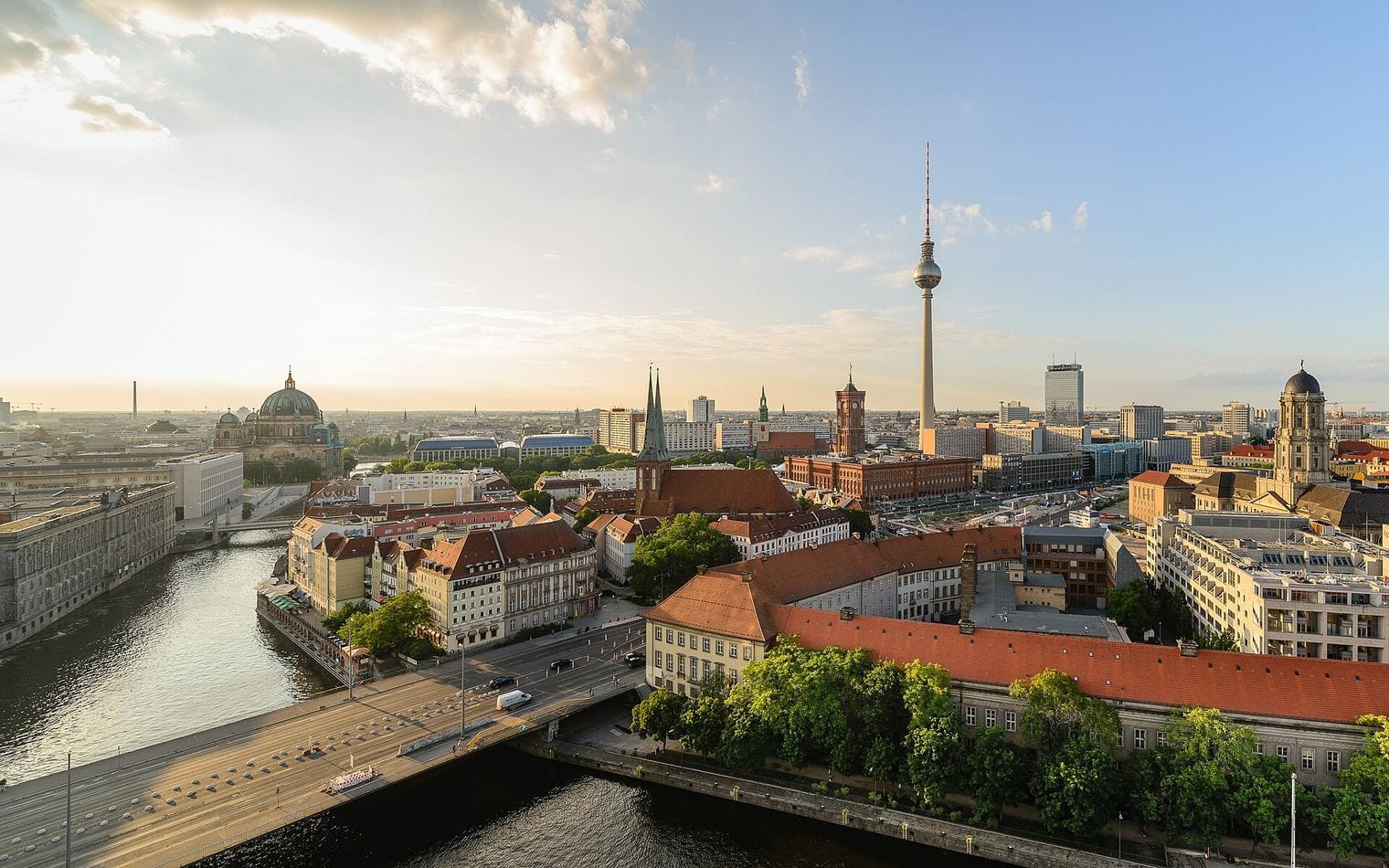
One country, a dozen worlds — imperial boulevards, half-timbered old towns, alpine castles and a beer garden for every season.
Germany sits at the heart of Europe — a country of grand cities, storybook castles, forested uplands and world-class museums, all knitted together by one of the fastest rail networks on the planet. Its restless capital, Berlin, wears a century of history in the open, while beyond it lie the beer halls of Bavaria, the fairy-tale Rhine, the Black Forest and the northern coasts. Use this hub to plan your trip: browse our German city guides below, or read on for the regions, seasons and rail routes that tie the country together.
Known for
Castles, beer culture, museums & history
Best for
Cities, road trips & the Christmas markets
Capital
Berlin
Main gateways
Frankfurt (FRA), Munich (MUC) & Berlin (BER)
Time zone
Central European (CET, UTC+1)
Trip planner
Plan your trip to Germany
Best time to visit — season by season
Spring
Mar–May
A fresh, greening shoulder season: the cities shake off winter, café terraces and beer gardens reopen, and orchards and vineyards along the Rhine and Mosel come into blossom. Early spring can still be grey and cool, but May is one of the loveliest months to travel.
Summer
Jun–Aug
The warmest and busiest window, with long daylight, open-air festivals and lakes and coasts at their best. Days are typically mild to warm rather than scorching; the Alps and Black Forest are ideal for hiking, and the beer gardens are in full swing. Expect crowds at the marquee sights.
Fall
Sep–Nov
Golden and atmospheric — Munich's Oktoberfest actually runs from mid-September, the Rhine and Mosel vineyards turn amber for the wine harvest, and the forests glow. September stays pleasant; by November the days shorten and the first cold snaps arrive.
Winter
Dec–Feb
Cold and often grey, dipping below freezing inland and in the mountains, but this is Christmas-market season — the squares of Nuremberg, Cologne, Dresden and beyond fill with mulled wine and lights through Advent. The Alps deliver reliable skiing, while the northern cities stay damp and dark.
Regions of Germany
Berlin & the northeast
The capital region and cultural heart, where Berlin lays out a century of history in the open — the Brandenburg Gate, the Wall, Museum Island — with the palaces and gardens of Potsdam just to the southwest and the lakes and Baltic beaches of Brandenburg and Mecklenburg beyond.
Bavaria & the Alps
Germany's postcard south, home to Munich's beer halls and Oktoberfest, the fairy-tale castle of Neuschwanstein, the alpine peak of the Zugspitze and baroque towns like Bamberg and Regensburg, all framed by the Bavarian Alps.
The Rhine & the west
The romantic river country of the Rhine and Mosel, lined with hilltop castles, terraced vineyards and wine villages, anchored by the great cathedral city of Cologne and the old capital of Bonn.
The Black Forest & the southwest
The dark wooded uplands of Baden-Württemberg, famous for cuckoo clocks, spa towns and hearty cooking, with the university city of Heidelberg and its castle, cosmopolitan Stuttgart and the university town of Freiburg on the forest's edge.
Hamburg & the north
The maritime north, where the great port city of Hamburg pairs its harbour and canals with a lively nightlife, alongside the Hanseatic brick towns of Lübeck and Bremen and the wind-swept beaches and islands of the North and Baltic Seas.
Saxony & the east
The cultural heart of the former east, where rebuilt baroque Dresden and its art collections sit on the Elbe near the sandstone gorges of Saxon Switzerland, with the historic trade-fair city of Leipzig close by.
Getting around
Germany is built for rail. The national network is fast, extensive and reliable, with high-speed ICE trains linking the major cities — Berlin to Munich in around four hours, Frankfurt to Cologne in barely one — so most travellers never need a car for a city-to-city trip. Every big city has its own U-Bahn, S-Bahn, tram and bus network under a single integrated ticket, and the historic centres are compact and walkable. A car earns its keep for the scenic routes — the castle-and-vineyard stretches of the Rhine, the Romantic Road through Bavaria, the Black Forest and the alpine foothills — where the Autobahn makes long drives quick. Germany sits at the crossroads of Europe, with major international airports at Frankfurt, Munich and Berlin and fast rail links on to neighbouring countries.
The highlights Germany's signature sights & road trips
Neuschwanstein Castle The fairy-tale hilltop castle of King Ludwig II in the Bavarian Alps — the most photographed castle in Germany and the model for Disney's.
Cologne Cathedral A soaring twin-spired Gothic masterpiece on the Rhine, one of the largest cathedrals in the world and Germany's most-visited landmark.
The Romantic Rhine A UNESCO stretch of the river valley lined with hilltop castles, terraced vineyards and wine villages, best seen by boat or on a scenic drive.
Munich & the Alps Bavaria's capital of beer halls and Oktoberfest, a gateway to the Alps, the Zugspitze and the baroque towns of the south.
Suggested routes
The classic Germany rail trip
~1–2 weeks
A high-speed rail loop that strings together the capital, the Bavarian south and the romantic west — no car needed, since fast ICE trains link every stop. Run it in either direction.
Neuschwanstein — day trip to the fairy-tale castle
The Rhine Valley — castles & vineyards by boat
Cologne — the great Gothic cathedral
Capital city break
3–4 days
A focused long weekend in Berlin, pairing the essential Cold War and imperial landmarks with the museums and neighbourhoods — an easy, walkable trip built around the U-Bahn.
Late spring (May–June) and early autumn (September) are the sweet spots — mild weather, open beer gardens and vineyards, and thinner crowds than high summer. Summer is warmest and best for the Alps, lakes and coast but busiest. December brings the famous Christmas markets, and the Alps deliver reliable skiing through winter, though the northern cities stay cold and grey.
How many days do you need in Germany?
A single city like Berlin or Munich rewards three to four days. A week lets you pair two cities with a scenic stretch such as the Rhine or the Romantic Road, and ten days to two weeks comfortably links Berlin, Bavaria and the west with time for castles, a wine region and a slice of the coast or the Black Forest. Germany's fast trains make covering ground easy.
Do you need a car in Germany?
Not for a city-based trip. The high-speed rail network links the major cities quickly and every city has excellent public transport, so most travellers never rent a car. A car does help for the scenic routes — the Rhine and Mosel valleys, the Romantic Road, the Black Forest and the alpine foothills — where having your own wheels opens up the villages and castles between the towns.
What is Germany best known for?
Germany is best known for its beer culture and Oktoberfest, its fairy-tale castles led by Neuschwanstein, its Christmas markets, and its layered history — above all Berlin and the Berlin Wall. It's also famous for its cars and engineering, its cathedrals and half-timbered old towns, and landscapes from the Bavarian Alps to the Black Forest and the romantic Rhine.
Is English widely spoken in Germany?
Yes, especially in the cities and among younger Germans, who generally speak good English — you'll manage easily in Berlin, Munich, Hamburg and the main tourist areas, where signage and menus are often bilingual. In smaller towns and rural areas it's less universal, but a few German pleasantries go a long way and travellers rarely run into serious language trouble on the main routes.
What currency does Germany use, and is it in the EU?
Germany is a founding member of the European Union and part of the Schengen Area, and it uses the euro. Card payments are increasingly accepted, but Germany remains more cash-friendly than many of its neighbours — it's wise to carry some euros for smaller cafés, bakeries, markets and the occasional ticket machine.
What should you eat and drink in Germany?
Beer is the national drink, brewed to centuries-old traditions and best enjoyed in a Bavarian beer garden or hall, alongside pretzels, roast pork knuckle (Schweinshaxe), schnitzel and a huge range of sausages — Berlin's currywurst and Nuremberg's grilled bratwurst among them. Look out for regional specialties like spätzle in the southwest, and mulled Glühwein at the winter Christmas markets.
We use cookies to analyse site traffic and improve your experience.
You can accept or reject analytics cookies. See our Cookie Policy.