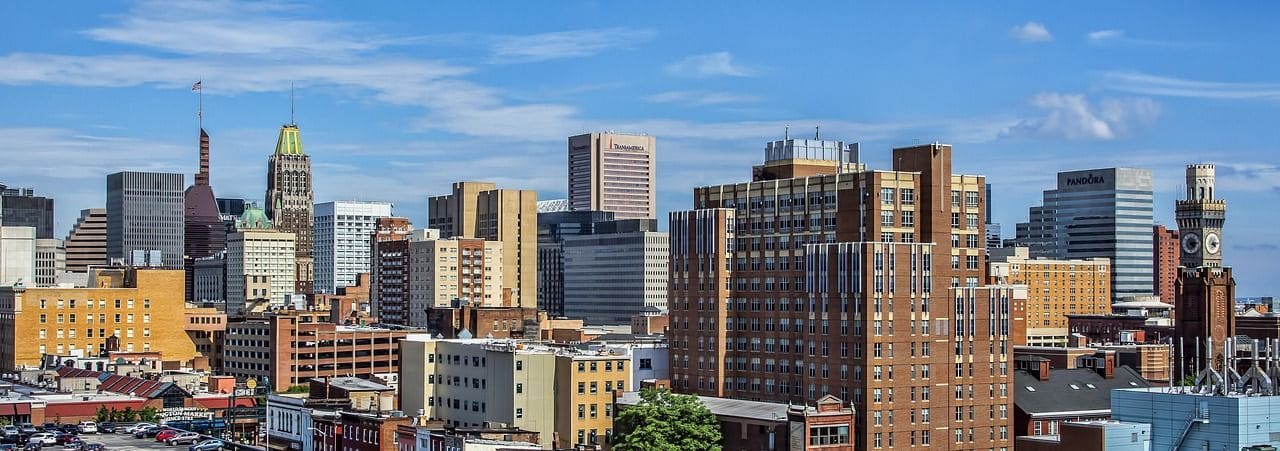
Few states put ocean beaches, a wild-pony barrier island, Colonial harbours and Appalachian lakes within a single afternoon's drive.
Maryland is a compact state that packs in a startling variety — the crab shacks and sailing towns of the Chesapeake Bay, the Atlantic dunes and wild ponies of Assateague, the harbours of Baltimore and Annapolis, and the forested Appalachian ridges out west around Deep Creek Lake. Use this hub to plan your trip: browse our city and adventure guides below to get started.
Known for
Chesapeake Bay & blue crabs
Best for
Seafood, sailing & Colonial history
Capital
Annapolis
Main gateway
Baltimore/Washington Int'l (BWI)
Time zone
Eastern (ET)
Trip planner
Plan your trip to Maryland
Best time to visit — season by season
Spring
Mar–May
A lovely, uncrowded window: cherry blossoms and dogwood around the Chesapeake, mild days in the 60s and 70s°F, and the sailing season getting under way at Annapolis before the summer heat and beach crowds arrive.
Summer
Jun–Aug
Peak season on the coast — Ocean City and Assateague fill up and the Bay towns hit their stride, though the air turns hot and notably humid inland. It's prime blue-crab season, so this is when the waterfront crab houses are at their best.
Fall
Sep–Nov
Arguably the finest all-round season: warm-water September beaches without the July crowds, crisp air and turning leaves across the western ridges and Deep Creek Lake, and the state's biggest sailing and seafood festivals along the Bay.
Winter
Dec–Feb
Cold and quiet at sea level, with the Bay towns and Ocean City in their off-season lull, while the western mountains around Deep Creek Lake get real snow and turn into Maryland's ski and snow-tubing corner.
Regions of Maryland
Baltimore & central Maryland
The populous heart of the state, where Baltimore pairs the Inner Harbor, Fort McHenry and the National Aquarium with quick access to BWI and, just south, the Colonial harbour and Naval Academy at Annapolis.
The Eastern Shore
The flat, water-laced half of the state across the Bay Bridge — the sailing town of St Michaels and its Maritime Museum, the working watermen's harbours, and the Atlantic run down to Ocean City and the wild ponies of Assateague.
Chesapeake Bay & Annapolis
The sailing capital of the country wrapped around the largest estuary in the US, where Annapolis anchors a shoreline of crab houses, marinas, lighthouses and waterfront towns on both shores of the Bay.
Western Maryland
The Appalachian corner, where the ridges rise toward Cumberland and the historic railroad, Rocky Gap State Park, and Deep Creek Lake — Maryland's four-season mountain retreat for boating, hiking and winter snow sports.
Capital region (the DC suburbs)
The inner-Beltway counties bordering Washington, DC, mixing suburban Montgomery and Prince George's County towns with the C&O Canal towpath running northwest along the Potomac toward Harpers Ferry.
Getting around
A car is the practical way to see Maryland end to end — the Eastern Shore beaches, the Bay towns and the western mountains are spread far apart and thinly served by transit between them. BWI is the main gateway and sits between Baltimore and Annapolis, both walkable harbour cities once you arrive. The Chesapeake Bay Bridge is the main link from the western shore across to Ocean City and Assateague, and it backs up badly on summer weekends, so time your crossing early. Out west, Interstate 68 carries you into the Appalachian ridges toward Cumberland and Deep Creek Lake.
The highlights Maryland's signature sights & road trips
Maryland highlights at a glance
Chesapeake Bay & Annapolis The sailing capital of the US, ringed by crab houses, marinas and the Colonial streets and Naval Academy of Annapolis.Basecamp: Annapolis
Assateague Island An undeveloped Atlantic barrier island famous for its free-roaming wild ponies, dunes and empty beaches.Basecamp: Ocean City
Ocean City Maryland's classic beach resort — a wide Atlantic strand, a lively boardwalk and amusement piers.
Deep Creek Lake The state's largest lake, a four-season Appalachian retreat for boating and hiking in summer and skiing in winter.
Antietam National Battlefield The rolling western Maryland fields that saw the bloodiest single day of the Civil War, now a preserved battlefield.
Suggested routes
Bay & beaches loop
~1 week
The classic Maryland circuit, linking the harbour cities of the western shore with the Chesapeake Bay towns and the Atlantic coast — a run through crabs, sailing, Colonial history and ocean dunes.
Baltimore — fly into BWI, start at the Inner Harbor and Fort McHenry
Annapolis — Colonial capital and Naval Academy
St Michaels — cross the Bay Bridge to the Eastern Shore sailing town
Ocean City — the Atlantic beach resort
Assateague Island — wild ponies and undeveloped dunes
Mountains & canal short trip
3–4 days
A focused long weekend into western Maryland, trading the Bay for the Appalachian ridges — the C&O Canal, the historic railroad at Cumberland and the four-season lake country of Deep Creek.
Late spring and early autumn are the sweet spots. May and September give you warm days without the peak summer crowds and humidity, and September is prime for both the beaches and the Bay festivals. Summer is high season on the coast at Ocean City and Assateague, while winter is quiet at sea level but brings snow to the western mountains around Deep Creek Lake.
How many days do you need in Maryland?
A long weekend of three to four days is enough to pair Baltimore and Annapolis, or to focus on the Eastern Shore beaches. To combine the cities, the Chesapeake Bay towns and a trip out to the western mountains at Deep Creek Lake, give yourself about a week so you're not spending it all in the car.
Do you need a car in Maryland?
For most trips, yes. Baltimore and Annapolis are walkable once you're there, and BWI is well connected by rail, but the beaches, the Bay towns and the western mountains are spread across the state and poorly linked by transit. A rental car is the practical way to combine more than one region.
What is Maryland best known for?
Maryland is famous for the Chesapeake Bay and its blue crabs — steamed and coated in Old Bay seasoning — along with Colonial history at Annapolis and Fort McHenry, the sailing and seafood culture of the Eastern Shore, and the wild ponies of Assateague Island.
What's the best way to get to Ocean City and Assateague?
Both sit on the Atlantic coast of the Eastern Shore, reached by crossing the Chesapeake Bay Bridge from the Baltimore–Annapolis side and driving east across the peninsula. The bridge is the main crossing and backs up on summer weekends, so aim to cross early in the day. Ocean City is the resort town; Assateague Island, with its wild ponies and undeveloped beaches, is just to the south.
Where can you see Maryland's wild ponies?
On Assateague Island, the barrier island on the Atlantic coast at the southern end of Ocean City. The Maryland herd roams freely through Assateague Island National Seashore and the adjoining state park, where you can see them from the beaches, dunes and marshes. Keep your distance — they're genuinely wild animals, not tame.
Is Maryland good for a Civil War or history trip?
Very much so. Antietam National Battlefield near Sharpsburg preserves the site of the bloodiest single day of the Civil War, and Fort McHenry in Baltimore is where the defence against the British in the War of 1812 inspired the Star-Spangled Banner. Annapolis adds Colonial streets and the US Naval Academy, and the C&O Canal traces the old waterway northwest along the Potomac.
What should you eat in Maryland?
Blue crab, above all — steamed hard crabs dusted in Old Bay and eaten by hand at a waterfront crab house, plus crab cakes and cream of crab soup. The Chesapeake also gives you oysters and rockfish, best enjoyed at the working watermen's towns of the Eastern Shore and the crab decks around Annapolis and the Bay.
We use cookies to analyse site traffic and improve your experience.
You can accept or reject analytics cookies. See our Cookie Policy.