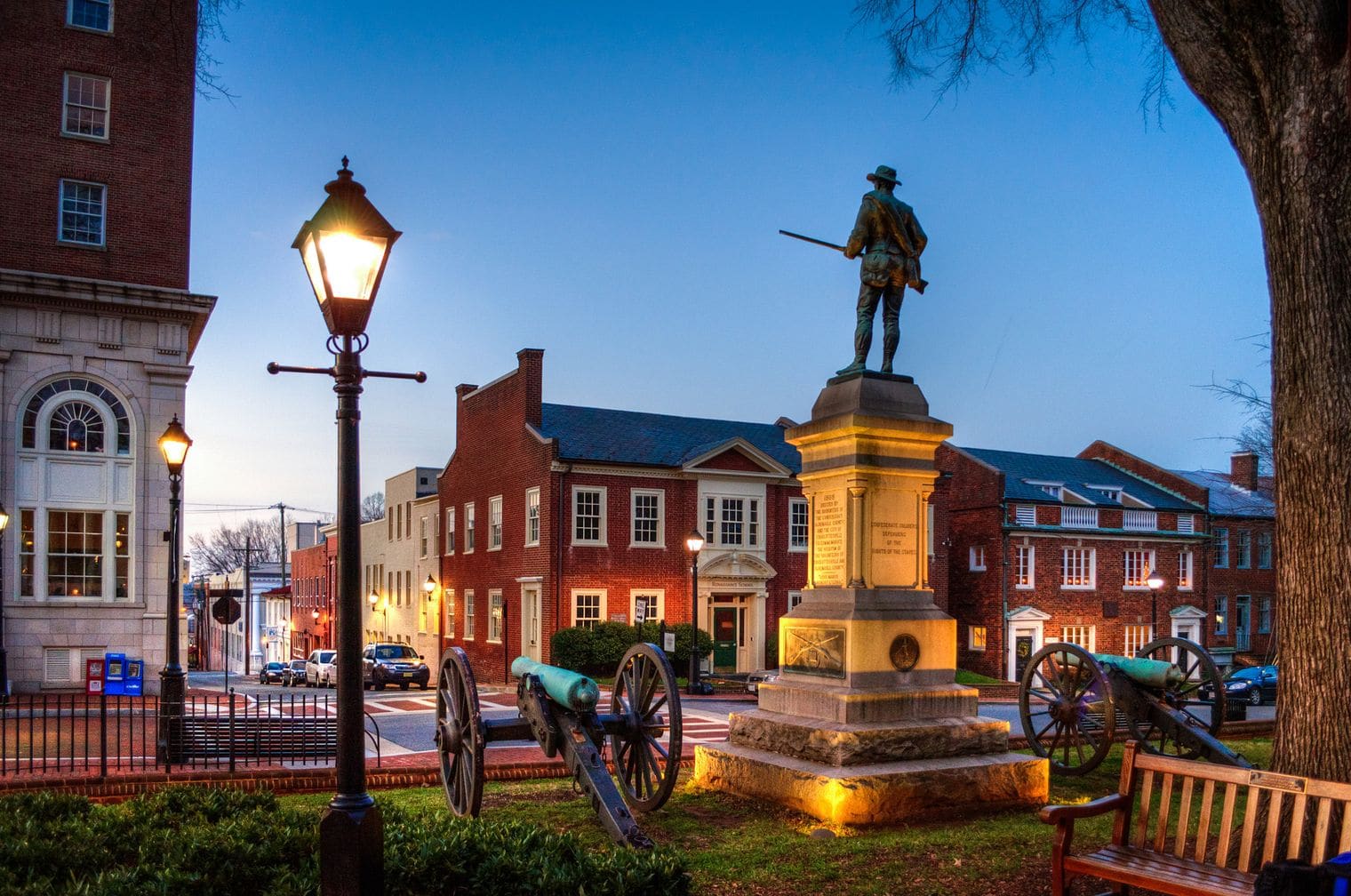
Few states let you walk a 400-year-old Colonial capital in the morning and drive a mountain crest road by afternoon.
Virginia runs from the Atlantic beaches and Colonial capitals of the Tidewater, through the rolling horse country and vineyards of the Piedmont, up to the Blue Ridge crest where Shenandoah National Park and Skyline Drive ride the mountains. It's a state where American history is unusually thick on the ground — Jamestown, Williamsburg, Yorktown, Monticello and the battlefields of the Civil War — set against genuinely scenic driving country. Use this hub to plan your trip: browse our city and adventure guides below to get started.
Known for
Colonial history & the Blue Ridge
Best for
History, scenic drives & wine country
Capital
Richmond
Main gateway
Washington Dulles (IAD)
Time zone
Eastern (ET)
Trip planner
Plan your trip to Virginia
Best time to visit — season by season
Spring
Mar–May
One of the loveliest windows: dogwood and redbud bloom across the Piedmont, the Skyline Drive wildflowers come on, and mild 60s and 70s°F days make Williamsburg and Monticello a pleasure before the summer humidity settles in.
Summer
Jun–Aug
Peak season on the coast, when Virginia Beach and the Eastern Shore fill up and the water is warm — but the lowland air turns hot and heavy with humidity, so the cooler, breezier Blue Ridge and Shenandoah Valley make the best summer escapes.
Fall
Sep–Nov
Arguably the finest all-round season: the Blue Ridge Parkway and Skyline Drive blaze with colour, the vineyards run their harvest, and crisp, clear days make it prime time for both the mountains and the historic towns.
Winter
Dec–Feb
Cold and quiet, with the coast in its off-season lull and the higher Blue Ridge occasionally dusted with snow. It's a fine time for the indoor history — Colonial Williamsburg is atmospheric under holiday decoration — and the small ski areas in the western mountains run when it's cold enough.
Regions of Virginia
Tidewater & Hampton Roads
Virginia's coastal corner, where the Historic Triangle of Jamestown, Colonial Williamsburg and Yorktown sits within reach of the Atlantic beaches at Virginia Beach and the harbours and naval history of Norfolk and Hampton Roads.
Shenandoah Valley & the Blue Ridge
The mountain heart of the state, where Skyline Drive rides the crest through Shenandoah National Park and the Blue Ridge Parkway carries on south, with Luray Caverns, Staunton and the valley towns strung along Interstate 81 below.
Central Virginia & the Piedmont
The rolling middle of the state, where Charlottesville pairs Jefferson's Monticello and the University of Virginia with a thriving wine country, on the way toward the state capital and Civil War history at Richmond.
Northern Virginia
The populous Washington, DC, suburbs, mixing Arlington National Cemetery and the Pentagon with George Washington's Mount Vernon estate, historic Old Town Alexandria and the waterfalls of Great Falls Park on the Potomac.
The Eastern Shore
The narrow Atlantic peninsula across the Chesapeake Bay Bridge-Tunnel, a quiet run of working watermen's towns leading up to Chincoteague and the wild ponies and empty beaches of Assateague Island.
Getting around
A car is the practical way to see Virginia, which is spread wide from the Atlantic coast to the Blue Ridge crest and only loosely linked by transit between regions. Most visitors fly into one of the Washington-area airports in Northern Virginia — Dulles or Reagan National — or into Richmond or Norfolk for the south and coast. Interstate 64 is the main east–west spine, running from the Tidewater through Richmond and Charlottesville and over the mountains, while Interstate 81 carries you the length of the Shenandoah Valley. The scenic Skyline Drive and Blue Ridge Parkway are destinations in themselves rather than through-routes, so budget extra time for their slow, winding miles.
The highlights Virginia's signature sights & road trips
Virginia highlights at a glance
Colonial Williamsburg & the Historic Triangle A restored 18th-century capital of costumed interpreters, paired with Jamestown and Yorktown on the Colonial Parkway.Basecamp: Williamsburg
Shenandoah National Park & Skyline Drive A 105-mile crest road of blue-hazed overlooks, waterfalls and Appalachian Trail hikes through the northern Blue Ridge.
Virginia Beach The state's classic Atlantic resort — a long strand, a lively boardwalk and the wild dunes of False Cape and Back Bay just south.
Blue Ridge Parkway The winding scenic road that carries on south from Skyline Drive through the Virginia highlands toward North Carolina.
Chincoteague & Assateague Island The Eastern Shore's wildlife refuge, famous for its free-roaming wild ponies, empty Atlantic beaches and birdlife.
Suggested routes
History & mountains loop
~1 week
The classic Virginia circuit, linking the Colonial coast with the central history and the Blue Ridge — a run from Jamestown and Williamsburg through Richmond and Charlottesville up onto Skyline Drive.
Williamsburg — start in the Historic Triangle — Jamestown, Colonial Williamsburg and Yorktown
Richmond — the state capital and Civil War history
Charlottesville — Monticello, the University of Virginia and wine country
Shenandoah National Park — drive Skyline Drive along the crest
Staunton — a valley finish in the Shenandoah
Blue Ridge & wine country short trip
3–4 days
A focused long weekend from Charlottesville, pairing Jefferson's Piedmont and its vineyards with a scenic run up onto the crest of the Blue Ridge.
Charlottesville — basecamp — Monticello, UVA and the surrounding wineries
Shenandoah National Park — the southern entrance to Skyline Drive is close by
Luray Caverns — the valley's famous cave system, on the way north
Spring and autumn are the sweet spots. April and May bring dogwood blooms and mild days across the Piedmont and the mountains, while September and October give you the finest colour on the Blue Ridge Parkway and Skyline Drive along with vineyard harvest season. Summer is peak time on the coast at Virginia Beach but hot and humid inland, and winter is quiet, cold and best for the indoor history towns.
How many days do you need in Virginia?
A long weekend of three to four days is enough to focus on one region — the Historic Triangle around Williamsburg, or Charlottesville and the wine country, or a scenic drive along Skyline Drive. To combine the coast, the central history and a run through the Blue Ridge, give yourself about a week so you're not spending it all behind the wheel.
Do you need a car in Virginia?
For most trips, yes. The historic towns, the coast and the Blue Ridge are spread across the state and only loosely linked by transit. Northern Virginia is connected to Washington, DC, by the Metro, but to reach Williamsburg, Charlottesville, the Shenandoah Valley or the beaches you'll want a rental car — and the scenic mountain drives require one.
What is Virginia best known for?
Virginia is famous for its depth of American history — Jamestown as the first permanent English settlement, Colonial Williamsburg's living-history town, the Yorktown battlefield, Thomas Jefferson's Monticello, and the Civil War battlefields around Richmond and Fredericksburg. It's also known for the Blue Ridge Mountains, Shenandoah National Park's Skyline Drive, and a fast-growing wine country around Charlottesville.
What is the Historic Triangle in Virginia?
It's the trio of Colonial-era sites in the Tidewater, linked by the scenic Colonial Parkway: Jamestown, where the first permanent English colony was founded in 1607; Colonial Williamsburg, a restored 18th-century capital staffed by costumed interpreters; and Yorktown, where the decisive Revolutionary War siege was won. Together they make one of the best history trips in the country and are easily seen over a couple of days.
Is Skyline Drive or the Blue Ridge Parkway better?
They're two halves of the same crest road and both are superb. Skyline Drive runs 105 miles through Shenandoah National Park in the north, with frequent overlooks and the park's trailheads close at hand; the Blue Ridge Parkway picks up where it ends and continues south through Virginia into North Carolina, a little wilder and more remote. For a short trip, Skyline Drive from a base like Charlottesville or the valley towns is the easiest introduction; autumn is the standout time on both.
Where can you see Virginia's wild ponies?
On Assateague Island, off the Eastern Shore near the town of Chincoteague. The Virginia herd lives in the Chincoteague National Wildlife Refuge, where you can spot the ponies from the trails, marshes and beaches. The famous annual pony swim across the channel is a long-running local tradition. Keep your distance — they're genuinely wild animals.
Is Virginia good for a wine trip?
Increasingly so. The rolling Piedmont around Charlottesville and Monticello has become the heart of Virginia wine country, with dozens of tasting rooms in the foothills of the Blue Ridge, and more clustered in the horse country of Northern Virginia. It pairs naturally with the region's history and scenic drives, making Charlottesville a popular base for a weekend of tastings.
We use cookies to analyse site traffic and improve your experience.
You can accept or reject analytics cookies. See our Cookie Policy.