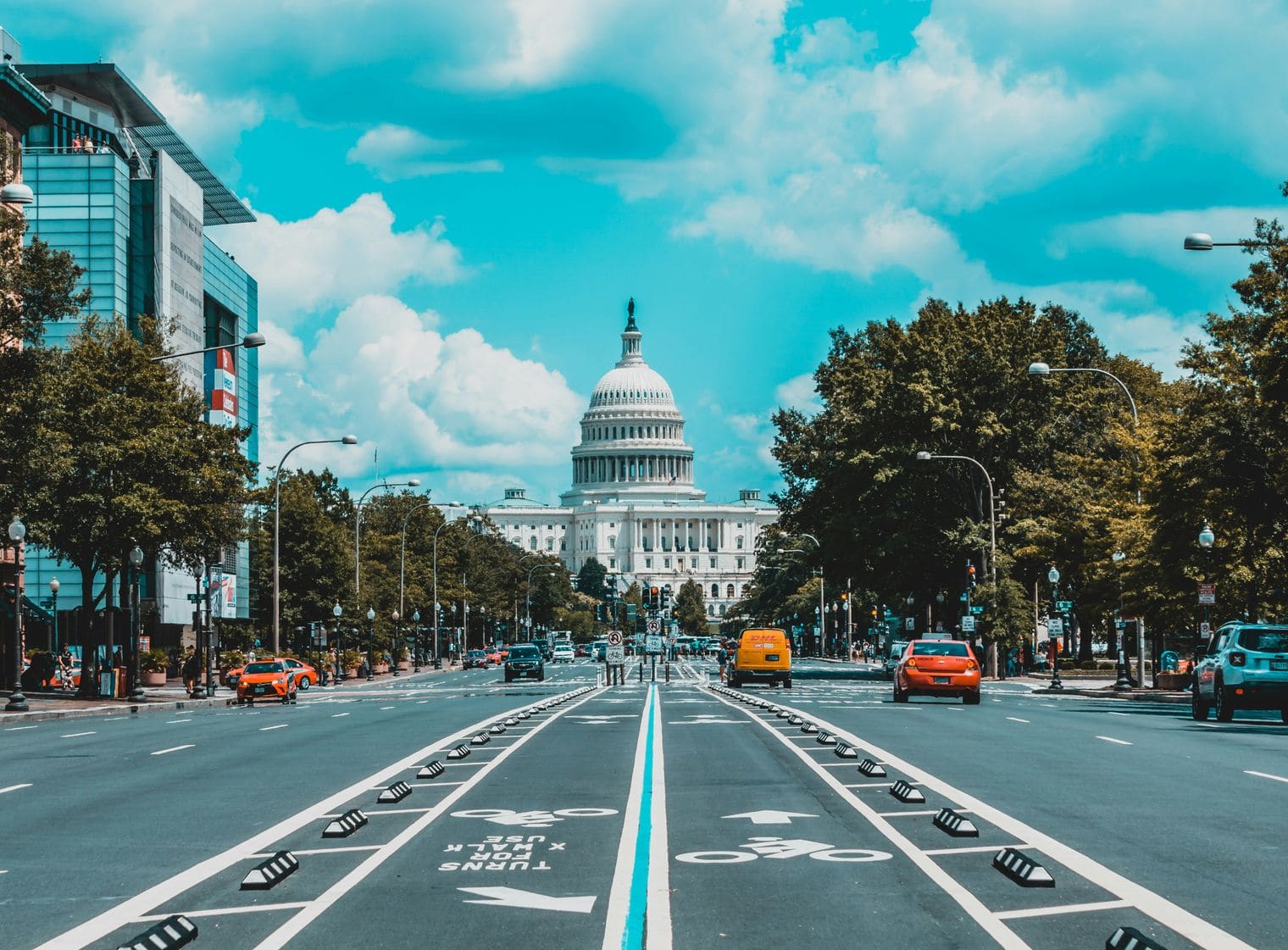
Few cities let you walk from a Vermeer to a moon rocket to the Lincoln Memorial in a single afternoon — and pay nothing to get in.
Washington, D.C. is the United States capital in miniature — a compact, monumental city where free world-class museums, the memorial-lined National Mall, and the buildings of American government all sit within a walkable few square miles. Use this hub to plan your trip: browse our Washington guide below for the headline sights, then use the neighborhoods, seasons and itineraries here to shape your days.
Known for
Monuments, memorials & free Smithsonians
Best for
Museums, history & walking
Capital
Washington (the District itself)
Main gateway
Reagan National (DCA) & Dulles (IAD)
Time zone
Eastern (ET)
Trip planner
Plan your trip to District of Columbia
Best time to visit — season by season
Spring
Mar–May
The signature season, when the Tidal Basin cherry blossoms bloom and the Mall is at its prettiest. Days warm into the 60s and 70s°F, though the exact peak-bloom window shifts each year and draws big crowds.
Summer
Jun–Aug
Hot and famously humid, often into the 90s°F with afternoon thunderstorms — the city sits on a muggy tidal river. Museums make cool refuges, and evenings on the Wharf or Georgetown waterfront are the move; congressional recess makes the town a touch quieter.
Fall
Sep–Nov
Arguably the best all-round window: warm, dry days ease into crisp ones, the humidity breaks, and Rock Creek Park and the Arboretum turn colour. Comfortable for long days of walking the Mall.
Winter
Dec–Feb
Cold and quiet, with occasional snow and short days, but the smallest crowds of the year and the whole indoor museum city to yourself. The monuments are striking floodlit on a clear cold night.
Regions of District of Columbia
The National Mall
The monumental core and the reason most people come: the Lincoln Memorial, Washington Monument, WWII and Vietnam memorials, the Capitol at the east end, and the free Smithsonian museums lined up along both flanks.
Downtown & Penn Quarter
The dense sightseeing heart north of the Mall, home to the White House, Ford's Theatre, the National Portrait Gallery and Smithsonian American Art Museum, and the National Archives.
Georgetown
The historic cobblestoned quarter on the Potomac, with the C&O Canal, the Georgetown Waterfront Park and Washington Harbour, boutique shopping along M Street and Wisconsin Avenue, and Georgetown Cupcake.
Capitol Hill & the Waterfront
The neighborhood around the US Capitol and Library of Congress, with Eastern Market's food stalls, Nationals Park down by the Anacostia, and the revitalised Wharf and Municipal Fish Market on the Southwest waterfront.
Upper Northwest & Rock Creek
The leafy uptown reaches, where the National Zoo, Washington National Cathedral, the Hillwood Estate and Adams Morgan's nightlife spread along and above the wooded corridor of Rock Creek Park.
Across the river: Arlington
The Virginia side within easy reach by Metro, anchored by Arlington National Cemetery, the Marine Corps (Iwo Jima) War Memorial and, farther out, the Pentagon.
Getting around
You do not need a car in Washington — it's the rare American city where a car is more hindrance than help, given tight parking and heavy traffic. The Metro (WMATA) rail system reaches most sights, museums and neighborhoods, and the National Mall and downtown are genuinely walkable end to end. Reagan National Airport sits just across the Potomac in Virginia with a direct Metro connection, making it the easiest arrival; Dulles is the larger international gateway farther west, and Baltimore/Washington (BWI) is a third option, both reachable by rail or bus. Save any rental for day trips out to Virginia and Maryland.
The highlights District of Columbia's signature sights & road trips
Arlington National Cemetery The nation's most hallowed military cemetery just across the Potomac, with the Tomb of the Unknown Soldier and Kennedy gravesite, alongside the nearby Marine Corps War Memorial.
Suggested routes
The classic Washington long weekend
3–4 days
A walkable first-visit loop hitting the monuments, the best free museums and the working government buildings, all reachable on foot and by Metro from a central base. No car needed.
A second-visit or slower-paced loop that trades the monument crowds for the city's living neighborhoods, markets and waterfront, plus the memorials across the Potomac in Arlington.
Spring and autumn are the sweet spots. Spring brings the famous Tidal Basin cherry blossoms and mild days, though it's the busiest window; autumn offers warm-to-crisp weather, thinner crowds and colour in Rock Creek Park. Summer is hot and very humid, and winter is cold and quiet but has the smallest crowds and the museums nearly to yourself.
How many days do you need in Washington, D.C.?
Three to four days is enough for a strong first visit — the monuments and the National Mall, a few of the free Smithsonian museums, and the White House and Capitol area. Add a day or two to slow down for the neighborhoods, markets and the waterfront, or to take a day trip out to Virginia or Maryland.
Do you need a car in Washington, D.C.?
No — this is one American city where you're better off without one. The Metro rail system reaches most sights and neighborhoods, and the National Mall and downtown are walkable end to end. Reagan National Airport has a direct Metro link, so you can arrive and get around without ever renting a car. Save a rental only for day trips beyond the city.
What is Washington, D.C. best known for?
The capital is best known for its monuments and memorials along the National Mall — the Lincoln Memorial, Washington Monument and the war and presidential memorials — the free Smithsonian museums, and the seats of American government: the White House, the US Capitol, the Supreme Court and the Library of Congress.
Are the museums in Washington, D.C. free?
Most of the marquee ones are. The Smithsonian museums — including Air and Space, Natural History, American History and the National Museum of African American History and Culture — and the National Gallery of Art and National Zoo are all free to enter. A handful of independent museums, such as the International Spy Museum and the National Building Museum's exhibitions, do charge admission.
Do you need tickets to visit the monuments or government buildings?
The outdoor monuments and memorials on the National Mall are free and open around the clock, no ticket required. The government buildings are different: the US Capitol, Library of Congress and Supreme Court can be toured, and White House tours must be arranged well in advance — typically through a member of Congress for US citizens or an embassy for many international visitors. Some free museums also use timed-entry passes at busy times, so it's worth checking each one's site before you go.
When do the cherry blossoms bloom in Washington, D.C.?
Peak bloom around the Tidal Basin usually falls in late March or early April, but the exact window shifts every year with the weather and lasts only a short time. If you're timing a trip around it, watch the National Park Service's peak-bloom forecast and be ready for large crowds during the National Cherry Blossom Festival.
Is Washington, D.C. a good base for day trips?
Yes. The city sits between Virginia and Maryland, with plenty within reach: historic Alexandria and Mount Vernon downriver, the Civil War battlefields and colonial towns of northern Virginia, Annapolis and the Chesapeake Bay in Maryland, and Baltimore a short train ride north. Most are easiest with a rental car, though several are reachable by regional rail or bus.
We use cookies to analyse site traffic and improve your experience.
You can accept or reject analytics cookies. See our Cookie Policy.